Open Inquiry Blog Post #5

I have officially been learning Italian for 3 weeks now! I am getting more and more comfortable with the language and am actually quite proud of my progress.

I had every intention of following through with my plan to experiment with the time of day at which I do my lessons, but I will confess that I have not stayed true to my plan. However, tomorrow I will start doing my lessons before bed, as suggested by the article that I read last week.

I saw my Nona this past week and made an effort to speak Italian with her, as I think my conversation skills are lacking. She does not speak true Italian very often; usually when she talked to relatives on the phone she speaks Calabrese, so I could tell it was a challenge for her to shift to formal Italian. Although we did not speak Italian together for long, I think that it was a valuable experience. My accent definitely needs work. I have an issue speaking in a fluid and natural way and, as a result, I sound pretty choppy. I think that this issue will resolve in time and with practice.

As a creature of habit, I have been enjoying my Duolingo Italian lessons every day. However, as I have mentioned in previous posts, Duolingo alone will not help me achieve a high level of fluency. I have been researching other supplementary methods and came across a useful article. One of the methods suggested in the article was the Michel Thomas audio lessons. My older brother used these when he was learning Italian and found them quite helpful, so I think I should try them out too.

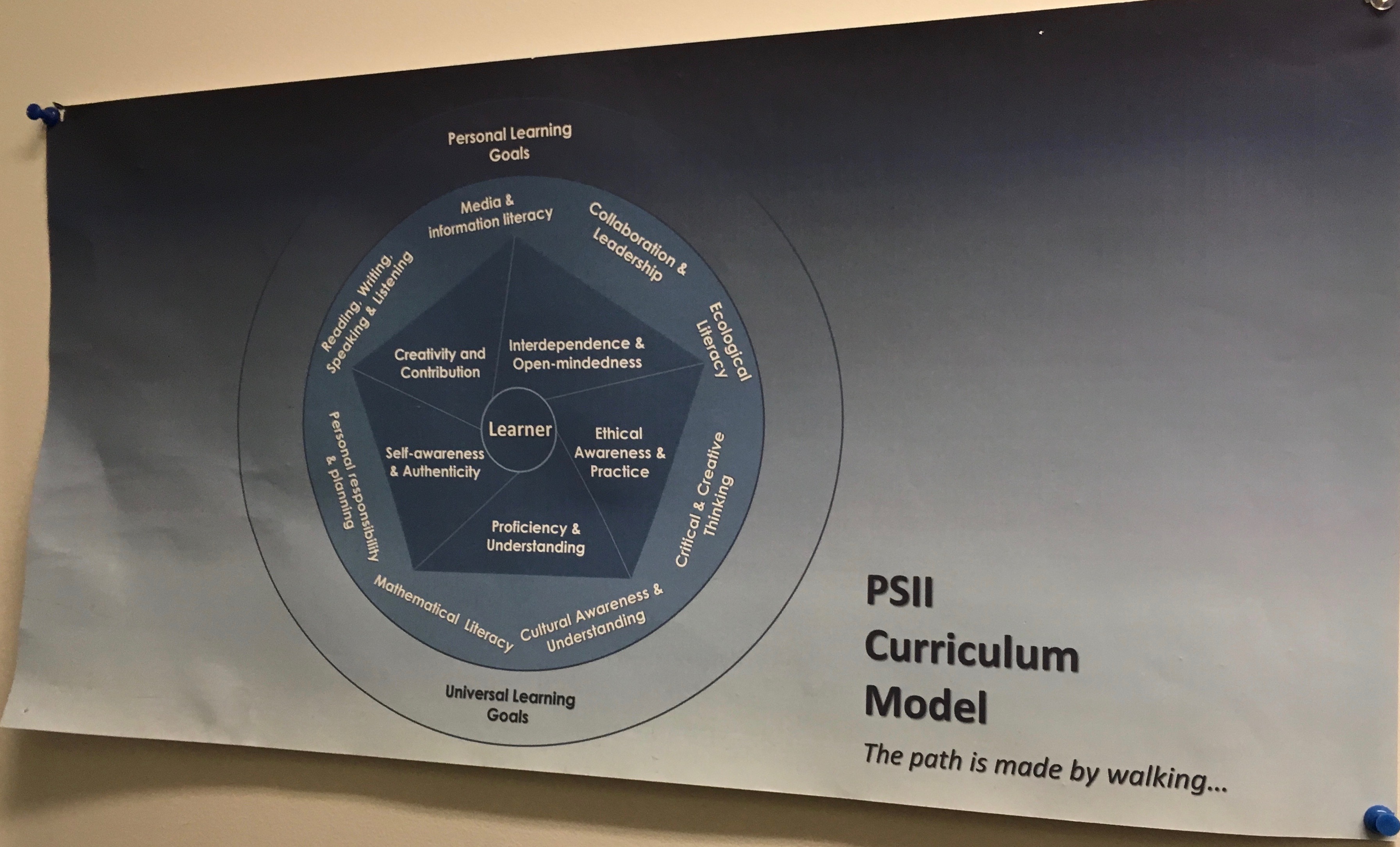
PSII Visit Reflection

Today our EDCI 336 class had the pleasure of visiting the Pacific School of Innovation and Inquiry (website is linked below). PSII, as the name suggests, focuses on individualized learning through inquiry. Each student has an individual learning plan that is based off of their own passions and interests.

The new BC curriculum emphasizes the importance of inquiry based learning. Because I was educated in a traditional school, my experience with inquiry based learning is limited. I am interested in learning about tools that can help me facilitate inquiry with my future students. PSII uses Trello to organize students’ inquiry projects and E-Portfolios as a place to save all of their work over the course of the year. PSII offers one on one sessions, group sessions, individual work time, and group work time, depending on each learners’ needs. They have a variety of different work spaces to accommodate all of the different needs of learners. During my visit, I spent a fair amount of time in the well equipped music room talking to one student. This student kindly took the time to describe his experience at PSII. Overall, it was quite positive. He said that he has learned a lot and that when he took a political science class at UVic last semester it was “pretty easy”. He was eloquent and clearly has a good sense of self. He not only answered our questions, but asked all of us questions about our lives too. One thing I was interested to know was approximately how much time an average learner at PSII spends per day. He answered honestly, saying that he looked at one screen or another for most of the day. This results in most PSII students being exceptionally adept with technology. Although that is positive in many ways, I do worry about the long term effects on learners that extended screen time may have. I also asked this student about his daily physical activity. Being active is a profoundly important part of my life, so I was curious about whether the school emphasized its importance. He said that he goes to the YMCA to exercise two days per week. The BC curriculum requires that students get a minimum of 150 minutes of exercise per week (which may translate to 30 minutes per school day). To me, it sounds like many of these students reach the bare minimum requirement, which is not ideal. Having said that, reaching the daily physical activity requirement is also an issue for many kids who attend traditional schools.

I was amazed to hear what the PSII learners are doing at a young age. There are kids designing clothing lines, makeup lines, curating art shows, starting up businesses, and many other ambitious projects. Overall, I think that PSII is a fantastic school and I feel very fortunate to have had the opportunity to visit.

PSII website: https://learningstorm.org/

Principal Jeff Hopkins’ Twitter: https://twitter.com/hopkinsjeff?lang=en

PSII Twitter: https://twitter.com/PSIIvictoria?lang=en

Trello: A Tool For Inquiry

Trello is a tool that allows students to take charge of their own learning. Trello helps students (or anyone, for that matter) to organize their projects. It helps students break down their projects into manageable components. It also facilitates collaboration. Trello users can invite others to be admins of their board. This makes working in a group much easier because you know what needs to be done, what is currently being done, and what has already been completed. This takes some of the anxiety that many students feel out of group work. Trello also ensures that users can take care of every tiny detail, while not losing sight of the bigger picture. Trello user friendly and highly visual. I love finding new ways to be organized, so I am very thankful that I have been exposed to Trello!

This is a picture of my Trello board for my open inquiry assignment.

In Class Lab: Audio and Video Editing

In Tuesday’s EDCI 336 class we experimented with audio and video editing with the help of Rich McCue (whose blog I will link below). I have had extremely limited experience with this technology, so I am grateful for the opportunity to expand my knowledge in this way. We learned about Screencastify (which I used in a previous blogpost), iMovie, and Garage Band. We did not have a lot of time to explore each of these tools thoroughly during class time, so I am going to make time to get familiar with them more throughout the semester. I am not sure how I, as a teacher, would use Garage Band for educational purposes in the classroom. It is beneficial, however, for me to know how to use tools like Garage Band in case one of my future students wanted to use it as part of an inquiry project. I can see myself using iMovie in the practical classroom setting. It is a fantastic way to create engaging presentations that will encourage students to participate actively. I also love the idea of creating instructional videos for students to reference. This would be especially useful for students who may need extra review on certain topics, or have had an extended absence for some reason. I would also encourage students to use iMovie as a presentation tool. IMovie gives students the chance to express their ideas in a unique way.

Rich McCue’s Blog: http://edci336.ca/rmccue/

Assessment, E-Portfolios, And Much, Much More…

Today the class had the pleasure of video-conferencing Ian Landy (whose blog I have linked at the bottom of this post), an educator who is an expert on using technology to document and make assessments based on student work. The video conference itself was a unique experience. To be completely honest, I was thoroughly distracted for the first 15 minutes of the class because I could see the mirror image of our class on one of the screens. When Ian changed the screen that was showing the image of the class to his slides, I was finally able to concentrate. The quality of the video conference was quite high, much higher than I am used to when I have used tools such as Skype and FaceTime in the past. The audio cut out a couple of times, but it did not detract from the overall experience.

In terms of content, Ian went above and beyond. I wish we had more time to talk to him because he clearly has a wealth of knowledge to share. I was fascinated by his approach to formative and summative assessment. I was shocked when he said that he hadn’t used letter grades in thirteen years. Are letter grades necessary? I pondered this question throughout his entire lecture and I will most likely ponder it for my whole degree.

I like Ian’s idea of using e-portfolios as a tool to facilitate pedagogical narration. I have paper portfolios from elementary school, filled with art work, math tests, essays, and I absolutely cherish them. Having the opportunity to make an e-portfolio for every student means that the teacher can include videos of the learning process or the final project. This is highly valuable because learning cannot always be easily expressed on paper. This approach also shows that learning is unique to each individual and works exceedingly well with the new inquiry based BC curriculum. I love the idea of giving every student a detailed portfolio that documents their progress, but I do think that it would be a difficult adjustment for me as a teacher. Ian did say that experienced teachers can complete portfolios quicker than they complete report cards, but it is still a rather daunting task.

Maeve, Me, Chloe, and Ian taking possibly the most awkward selfie of all time. I love it.

Ian Landy’s blog: https://technolandy.wordpress.com/

Open Inquiry Blog Post #4

Today is day 14 of my adventure of learning Italian, and I daresay that I have had somewhat of a breakthrough. When I first started Duolingo, I did not have any intuitive sense of how to construct sentences. I could recognize some words, but I could not put them together in any meaningful way. Today, I found myself putting together a simple sentence without thinking about it. This led me to think about the concept of active learning/participation. I have been actively participating in every lesson (speaking aloud as I type out my answers, making a real effort to process the information), but I only recognized my progress when I was participating more passively. I suppose the passive participation allowed me to test out my muscle memory.

Today also marks the beginning of an experiment that I am going to do on myself. I read an article that made me wonder if I could further my learning by changing the time of the day at which I practice my learning. The article, linked below, said that many people found that practicing their language at night, right before they went to sleep, helped them retain the information better. I have been completing my Duolingo lessons relatively sporadically, sometimes right when I wake up in the morning, sometimes at night, and other times in between classes. For the next week, I am going to do all of my practice in the morning. The week after, I will try right before I go to bed. This will not, by any means, give me conclusive evidence; I may not even notice a difference! However, there is no harm in testing it out for myself.

Today in class we talked about screen recording. I am going to use my new found screen recording ability to show you what a Duolingo lesson consists of.

https://drive.google.com/file/d/1yf7IfyGwU67Q8lPwnV20vxNy_Uh64Awn/view

https://qz.com/1215361/the-best-time-of-day-to-learn-a-new-language-according-duolingo-data/

Open Inquiry Blog Post #3

Today is day 8 of my mission to learn Italian (and also day 8 of my duolingo streak!)

I have started to recognize some basic words (types of food, clothing, etc.) and have just started learning the possessive. Duolingo asks learners to answer different types of questions by either typing out the answer, saying the answer out loud, or picking from a list of possible answers. This is beneficial because it challenges the learner to apply the words/concepts in different scenarios. Many of the phrases are conversational and are applicable to every day life. There are quite a few, however, that I am quite sure that I will never use. For example, one of the phrases that I have learned from Duolingo is: “l’orso mangia la mi bistecca” which means “the bear eats my steak”. But perhaps my perception of Italy is flawed, maybe this phrase will serve me well on my trip in May. Maybe, on a beautiful night in Positano, I will be sitting eating my dinner only to be rudely interrupted by a bear, who has come to eat my steak. I will be grateful to Duolingo as I call out, “l’orso mangia la mi bistecca!”

I do not think that doing Duolingo alone will help me develop a command of the Italian language. I my plan for this week is to learn some vocabulary and write it out using a pen and paper. Personally, I find it harder to remember things that I have written out via keyboard, so I think that this method may help me. I am also going to see my Nona this week and hopefully I can learn more conversational phrases with her.

In my last post, I talked about how I changed the language on my social media platforms to Italian. I wish I could say that this has been an effective strategy for me, but it has not been as successful as I had hoped (so far). I am so used to seeing notifications from these media platforms (facebook, instagram, pinterest) that I do not even read the notification anymore because I just recognize it and automatically understand what it means. Maybe I am speaking too soon, but as of right now I do not think that this is a revolutionary method. Seeing my notifications come up in Italian does remind me to do my Duolingo practice everyday, so that is one benefit!

Ed Camp Reflection

Today I participated in my first Ed Camp. My group (of about 15-20 of my peers) discussed accommodation in the elementary school classroom. We also talked about whether or not discomfort can be beneficial. In the informal setting, we talked about different scenarios in our own lives in which we felt that accommodation was beneficial or detrimental to our learning. It became clear that all of us had different opinions based on our unique experiences. Some people in the group felt uncomfortable with the culture of “excessive accommodation” that is prevalent in many classrooms in 2019. These members of the group felt that some discomfort (whether that is speaking in front of a group, using media that they are not familiar with, etc.) can be beneficial to student learning. In some cases, students need a push to achieve their potential. Other members of our group argued, however, that pushing certain kids can result in them being turned off from learning and feeling psychologically unsafe. We all agree, for the most part, that knowing your students is of the utmost importance. Students all have different needs and therefore teachers may need to use different strategies in order to help each individual student.

Using an Ed Camp was helpful to work through this challenging question. All of us were able to discuss the issue in a non-hierarchical way. Nobody was leading the discussion, and nobody was an expert on the issue. It was an egalitarian way to start respectful discourse.

Open Inquiry Blog Post #2

Why are some people better at learning languages than others are? What is the secret? One of my older brothers can speak English, Spanish, French and Italian. I always thought that he simply possessed a “language gene” that I do not have. However, after watching Lydia Machová’s TED Talk on learning language, I have changed my mind…

In her talk, Lydia says that there are four important components to learning a new language quickly and effectively:

  1. Enjoyment: The learner must use a method (talking to other people, making lists of new words, watching Netflix in your desired language, etc.) that they enjoy. Polyglots (people who speak many languages) all use different methods to learn new languages. The way in which one person learns a new language may be completely different than how another person may learn. Any method that keeps you engaged and interested is valid!
  2. Methods: If the learner wants to achieve fluency in a new language, they must use methods that will store new words and information in their long term memory rather than their short term memory. Lydia suggests reviewing the new information every few days. She suggests using apps such as Memrise or Anki to help with this practice. She also suggests looking up different polyglots on YouTube and seeing what their favourite methods are.
  3. System: Lydia emphasizes the importance of establishing a systematic language learning routine into our daily lives. She suggests waking up 15 minutes earlier than usual to review vocabulary or listening to a foreign language  podcast during your commute. 
  4. Patience: Skill acquisition takes time. Whether you are learning to shoot a    proper layup in basketball, learning to use Wordpress, or learning a new language, time, effort, and patience are always necessary. 

Lydia mentioned that when she was learning German, she watched the TV show Friends on Netflix in German. I think that is a brilliant method! I decided to take Lydia’s advice and change the language on my Netflix to Italian so that I can watch all of my favourite shows while still being productive! After a little bit of research, I found out that there are only 17 movies that I can watch on my Canadian Netflix account in Italian. That’s right, only 17. There may be a way to change the settings on Netflix to make it work (possibly through a VPN) but I am not sure how to do that. If anyone knows how to make this work, please let me know. If I could watch The Office in Italian, I would learn so quickly!

After I changed the language on my Netflix, I thought: why not change the language from English to Italian on all of my social media? I changed the language settings on my Facebook, Instagram, and Pinterest.

That’s it for now, arrividerci!

Open Inquiry – Blog Post #1

For my open inquiry project, I have decided to learn Italian. I am one quarter Italian, but did not grow up speaking Italian at home (apart from the odd idiomatic word or phrase). As I have gotten older, I have realized the importance of staying in touch with one’s culture. Not only does this connect one with one’s family, but it helps one connect with a deeper part of oneself. I am going to Italy in May and would like to have at least a rudimentary understanding of the language before I go.

I have a few ideas on how to begin, but hopefully will gain more insight along the way. My first idea is to do learn Italian through the website duolingo. I have created a profile and selected the 15 minute per day option.

“Insane” sounded a little scary, so I decided to select “serious” instead.

My next strategy will be to talk to my Nonna (my grandmother). She grew up speaking Calabrese, an Italian dialect, but also knows formal Italian quite well. Every time I see her, I will try to learn a few new words–besides just different types of pasta!

I am feeling excited to honour part of my heritage in this way. I do not know where my speaking ability will be by the end of the semester, but hopefully these two steps will take me in the right direction.